
If you’ve received an offer on your house with the word “contingent” attached, or you’re a buyer trying to decide whether to add conditions to your own offer, you’re probably asking the same question most homeowners ask at this stage: how does a contingent offer work, and what does it actually mean for the timeline and certainty of a sale?
In plain terms, a contingent offer is an agreement to buy or sell a home that only becomes fully binding once certain conditions are satisfied.
Understanding what those conditions are and the risks they carry for a seller can help you decide whether accepting one is the right move for your situation.
What Does a Contingent Offer Mean in a Home Sale?
So what does a contingent offer mean in practice? It means the buyer has agreed to purchase the home, but the deal is conditioned on one or more specific requirements being met before closing.
If a contingency isn’t satisfied say, the buyer’s financing falls through, or an inspection turns up a problem they aren’t willing to accept the buyer typically has the right to renegotiate or walk away from the contract, often with their earnest money deposit returned.
A contingent offer on a house is not the same as a done deal. It’s a conditional promise, and until those conditions clear, the sale isn’t guaranteed.
You’ll often see a home’s listing status change to “contingent” once a seller accepts this kind of offer.
That status tells other potential buyers the home is under contract but not yet sold outright, which is different from “pending,” a stage that usually means the major contingencies have already been cleared.

How Does a Contingent Offer Work, Step by Step?
The mechanics are fairly consistent from one transaction to the next, though local practices and paperwork vary by state and by local market conventions.
- The buyer submits an offer that includes specific contingencies spelled out in the purchase agreement, along with deadlines for each one.
- The seller accepts the offer, and the property typically moves to “contingent” status on listing sites.
- The buyer works to satisfy each contingency within the agreed timeframe ordering an inspection, applying for a loan, or selling their own home, for example.
- Contingencies are cleared one by one, or the buyer requests repairs, a price adjustment, or an extension if something doesn’t check out.
- If every contingency is resolved, the sale proceeds to closing. If a major contingency fails and can’t be resolved, the buyer generally has a legal way to exit the contract.
Timelines for these steps usually range from a couple of weeks to 30-45 days, depending on the type of contingency and how quickly lenders, inspectors, and other parties can move.
Common Types of Contingencies Buyers Include
Not all contingencies carry the same level of risk for a seller. It helps to know what you’re likely to see.
Financing Contingency
This protects the buyer if they’re unable to secure a mortgage. It’s one of the most common contingencies and also one of the more significant risks for a seller, since loan approvals can fall through late in the process for reasons outside anyone’s control.
Inspection Contingency
This allows the buyer to have the home professionally inspected and to request repairs, a credit, or to cancel the contract if serious issues are found.
Appraisal Contingency
If the home appraises for less than the agreed purchase price, this contingency lets the buyer renegotiate the price or exit the deal, since most lenders won’t finance more than the appraised value.
Home Sale Contingency
This is often the one sellers should scrutinize most closely. It makes the purchase dependent on the buyer first selling their current home. If that sale stalls, your transaction stalls with it, sometimes for months.
What a Contingent Offer Means If You’re Selling
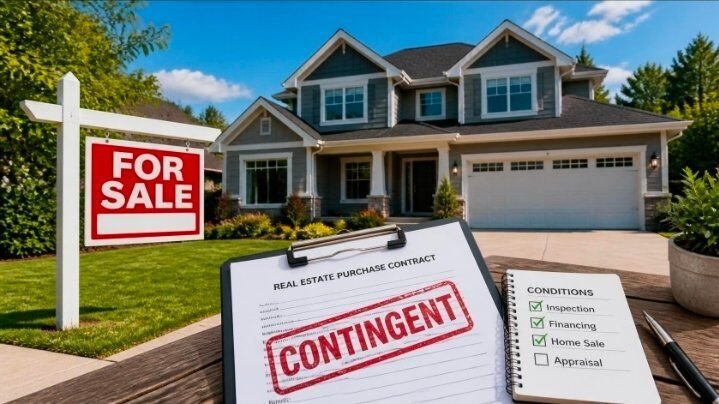
Accepting a contingent offer on a house means you’re taking your home off the active market or at least signaling to other buyers that it’s under contract while still facing a real chance the deal doesn’t close. That uncertainty is the core trade-off.
On the upside, contingent offers are often the majority of offers you’ll receive, especially from buyers who need to finance their purchase, so refusing to consider one at all can significantly narrow your buyer pool.
Some sellers negotiate a “kick-out clause,” which allows them to keep marketing the home and accept a backup offer if the original buyer can’t remove their contingencies within an agreed window.
This can be a reasonable middle ground, though it adds complexity to the contract and should be reviewed by a real estate attorney or experienced agent, since contract language and enforceability can vary by state.
Should You Accept a Contingent Offer?
Whether to accept one usually comes down to a few practical questions:
#1. How strong is the buyer’s position? A pre-approval letter from a reputable lender, a solid down payment, and a straightforward inspection contingency generally carry less risk than a buyer whose offer depends on selling their own home in a slow market.
#2. How much time pressure are you under? If you need to close by a certain date for a job relocation, a new purchase, or financial reasons a contingent offer’s uncertain timeline may not fit your needs.
#3. What does your local market look like? In a competitive market with multiple offers, you may be able to hold out for a less contingent, or non-contingent, offer. In a slower market, a contingent offer might be your best realistic option.
#4. What are the financial consequences if it falls through? Consider how much time you’d lose relisting the home, and whether carrying costs mortgage payments, taxes, insurance, or a home you’ve already started moving out of make a failed contingent sale especially costly for you.
There’s no universal right answer. A contingent offer can work out fine, and often does, but it inherently trades some certainty for a potentially larger buyer pool or a higher price. Sellers who most need a firm, predictable close date are usually the ones who feel that trade-off most.
Alternatives If You Want More Certainty
If the uncertainty of a contingent offer doesn’t fit your timeline or your tolerance for risk, you do have other options.
You can hold out for a cash buyer with no financing or home-sale contingency, negotiate a shorter contingency window, or request a larger earnest money deposit to discourage a buyer from walking away over a minor issue.
Selling directly to a cash home-buying company is another path some homeowners choose specifically because it removes financing and appraisal contingencies from the equation entirely, since there’s no lender or mortgage approval involved.
Get a Straightforward, No-Contingency Cash Offer
If you’re weighing a contingent offer against the stress of an uncertain closing date, or you’d simply rather skip the financing and appraisal contingencies altogether, we buy houses for cash, as-is, in any condition, with no lender approval to wait on.
At webuyhousesfastusa.com, we can provide a no-obligation cash offer and let you choose a closing timeline that works for you.
If you’d like to compare that certainty against the offers currently on your table, reach out for a free, no-pressure cash offer today.