
If you’re trying to figure out what your house is worth, you’ve probably run into the term “comps” pretty quickly.
Sold comparables- recently sold homes similar to yours in size, condition, and location- are the backbone of almost every valuation method, from a bank appraisal to a real estate agent’s listing recommendation to a cash buyer’s offer.
Understanding how they work can help you make sense of the number you’re seeing, whether it feels too high, too low, or just confusing.
What Are Sold Comparables, Exactly?
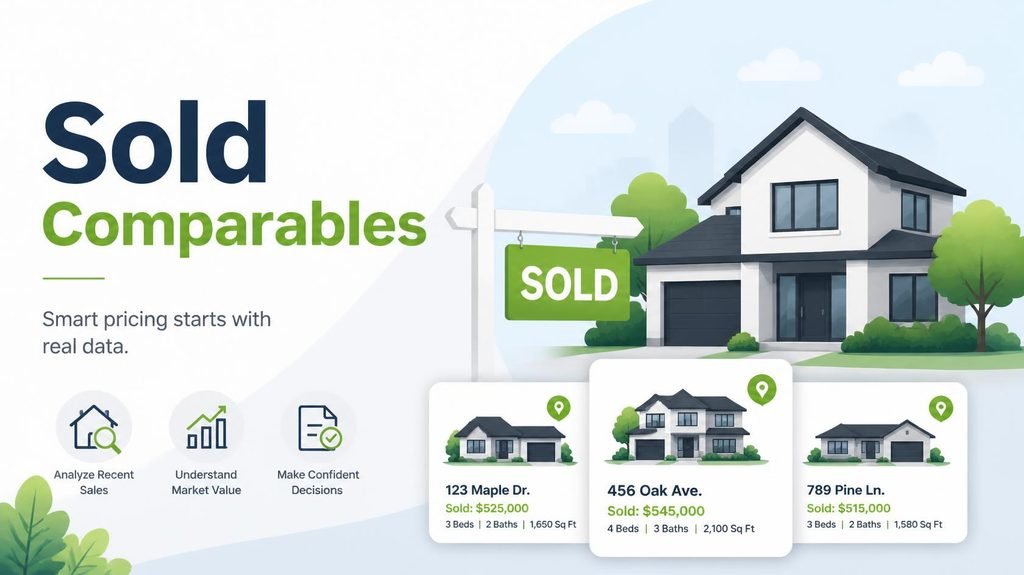
Sold comparables, often just called “comps,” are homes that have recently sold and share enough in common with your property that their sale prices offer a reasonable stand-in for what yours might sell for.
A good comp typically matches your home on a handful of key traits:
#1. Similar square footage (usually within 10-20%)
#2. Same or similar neighborhood, often within a mile
#3. Comparable age, condition, and style
#4. Similar number of bedrooms and bathrooms
#5. A recent sale date, typically within the last three to six months
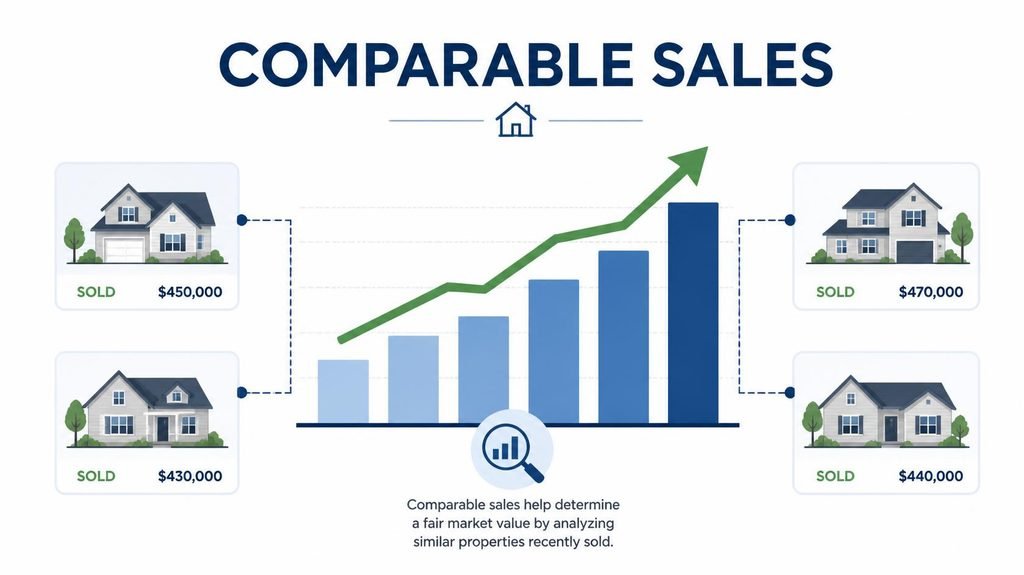
The idea is straightforward: if three homes very similar to yours sold for around $250,000 in the last few months, that’s strong evidence your home is worth something in that range too, assuming it’s in similar shape.
Comps vs. Listings
It’s worth noting that comps are based on closed sales, not asking prices. A neighbor’s home listed for $300,000 doesn’t tell you much on its own; what matters is what buyers actually agreed to pay once the deal closed.
That’s why comparable sales are more reliable than active listings for estimating value.
How Comps Are Selected
Appraisers, agents, and buyers don’t just grab the three closest recent sales and call it a day. There’s usually a process behind it, even if it’s informal:
Geographic Proximity
The closer a comp is to your home, the more weight it usually carries, since location affects schools, walkability, and neighborhood desirability.
In dense urban areas, comps might come from a few blocks away. In rural areas, the search radius often has to widen considerably just to find enough sales data.
Property Similarity
A one-story ranch isn’t a great comp for a two-story colonial, even if they’re next door. Appraisers generally try to match structural style, lot size, and major features like garages, pools, or finished basements.
Time Frame
Markets shift, sometimes quickly. A sale from 18 months ago may no longer reflect current conditions, so appraisers typically weight more recent sales more heavily than older ones.
How Comparable Sales Translate Into Market Value
Once you gather a set of comps, the next step is adjusting for differences.
If a comp has an extra bedroom, a newer roof, or a finished basement that your home lacks, its sale price gets adjusted downward to estimate what it might have sold for without that feature, and vice versa if your home has something the comp doesn’t.
These adjustments are estimates, not exact science, which is part of why two professionals can look at the same set of comparable sales and land on slightly different numbers for the market value of the home in question.
This adjusted range is generally how appraisers arrive at an appraised value, how agents set a listing price, and how many cash buyers structure their initial offers.
It’s not the only factor; condition, repairs needed, and local demand all play a role, but comps are usually the starting point.
Common Comp Mistakes That Skew a Home’s Value
Because comps involve judgment calls, the process can easily go sideways. A few issues homeowners run into:
#1. Using comps that are too far away or too old. In areas with limited recent sales, this can happen even when everyone involved is doing their best.
#2. Ignoring condition differences. A fully renovated comp isn’t a fair match for a home that needs a new roof, updated electrical, or cosmetic repairs, unless those differences are properly adjusted for.
#3. Overlooking unique features or drawbacks. Busy roads, unusual lot shapes, or shared driveways can pull value down in ways a simple square-footage comparison misses.
#4. Relying on automated estimates alone. Online valuation tools use comparable sales data too, but they can’t always see a home’s actual condition, which is a major limitation.
What Homeowners Can Do When Comps Work Against Them
If your home needs significant repairs, sits on an odd lot, or is in a neighborhood with little recent sales activity, sold comparables can work against you rather than for you. A few options worth considering:
Request the Comp List
If you’re getting an appraisal or a valuation from an agent, ask to see which comparable sales were used and how adjustments were made.
This transparency can help you understand and sometimes reasonably challenge a number that seems off.
Weigh the Cost of Getting “Comp-Ready”
Sometimes the gap between your home’s current condition and what comps assume is large enough that repairs, staging, or a full listing process would take significant time and money before a traditional sale could close.
Consider Whether a Traditional Sale Fits Your Timeline
Waiting for the right buyer, negotiating repairs after inspection, and hoping the appraisal matches the agreed price are all part of a conventional sale.
For some homeowners, that process makes sense. For others, especially those dealing with a tight timeline, an inherited property, or a home that needs more work than they want to take on, it doesn’t.
Comps vs. Cash Offers: What’s Different
A cash home buying company still looks at comparable sales when putting together an offer, but the process tends to work differently than a retail sale.
Because the buyer is purchasing the home as-is, factors like needed repairs, clutter, or deferred maintenance are built directly into the offer rather than negotiated after an inspection contingency.
There’s also no lender-ordered appraisal to wait on or worry about falling short, since there’s no financing involved.
That can mean a faster, more predictable path from offer to closing, even if the top-line number differs from what a fully renovated comp-based listing price might suggest.
Every state and local market has its own quirks around disclosure requirements, closing timelines, and paperwork, so it’s always a good idea to confirm specifics with a local professional or your state’s real estate authority before finalizing any sale.
Get a Straightforward Cash Offer Based on Your Home’s Real Condition
Sold comparables are a useful starting point, but they don’t always capture the full picture of a specific property — especially one that needs work or sits in a slower-moving market.
If you’d rather skip the back-and-forth of listings, showings, and appraisal contingencies, webuyhousesfastusa.com can provide a no-obligation cash offer based on your home as it actually is today.
There’s no pressure to accept, and it’s a simple way to see what a fast, as-is sale might look like for your situation.