
If you’ve started researching how to sell your house fast for cash, you’ve probably run into two very different types of buyers that can look nearly identical at first glance: wholesalers and direct cash buyers.
Understanding the wholesaler vs. direct cash buyer distinction matters more than it might seem because it affects who you’re signing a contract with, how firm your closing date really is, and how certain you are the deal will close at all.
This guide breaks down what each one does, how they make money, and how to tell them apart before you sign anything.
What Is a Wholesaler?
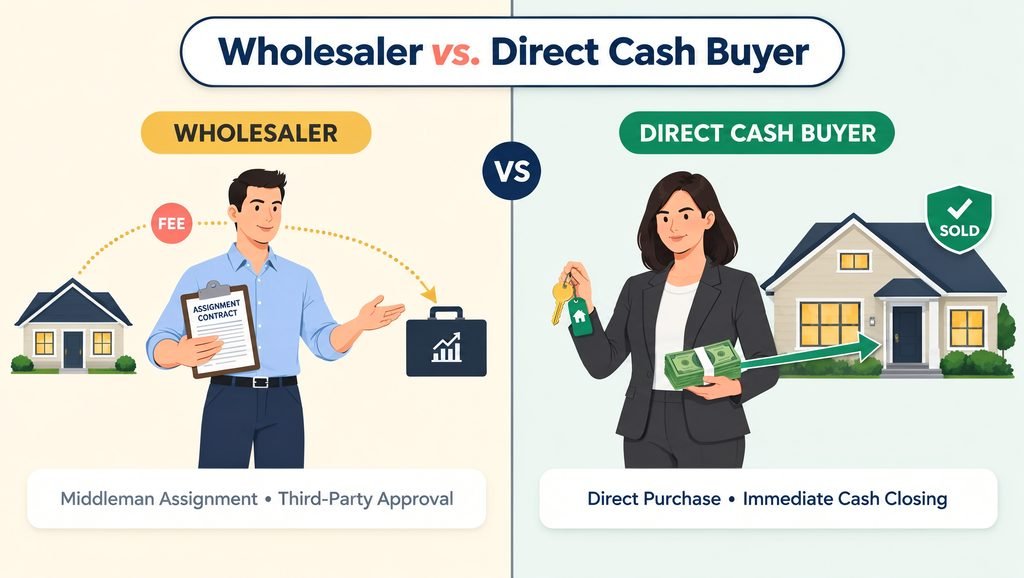
A wholesaler is not actually buying your home. Instead, a wholesaler puts your property under contract at an agreed price, then markets that contract to real investors, hoping to sell (or “assign”) the right to purchase your home to someone else for a higher price.
The difference between what they contracted with you and what they resell the contract for is their profit, often called an assignment fee.
This isn’t inherently illegal or unethical; wholesaling is a legitimate part of real estate investing, and many wholesalers operate honestly and disclose exactly what they’re doing.
The problem for homeowners is that a wholesale contract adds uncertainty. If the wholesaler can’t find another buyer willing to pay more than your contract price, the deal can fall through, sometimes close to your expected closing date, leaving you back at square one and having lost valuable time.
What Is a Direct Cash Buyer?
A direct cash buyer is a company or individual that intends to purchase your home with their own funds (or already-secured financing) and close the transaction themselves.
No middleman contract is shopped around to other investors. When a direct buyer makes an offer, they are the party who will actually show up at closing, sign the deed transfer, and wire the funds.
Because a direct buyer isn’t relying on a second buyer to make the math work, their offer is generally the price they intend to pay, and they control the timeline they propose.
That doesn’t mean every direct buyer is a great fit for every situation, but it does remove one significant layer of uncertainty from the process.
Wholesaler vs Direct Cash Buyer: Key Differences
On the surface, both types of buyers often advertise the same way: “sell your house fast,” “cash offer in 24 hours,” “no repairs needed.” The differences show up once you look at the mechanics behind the offer.
Who Actually Closes on Your Home
With a direct buyer, the person or company you negotiate with is the same one who closes. With a wholesaler, you’re signing a contract with one party, but the actual buyer at closing may be a completely different, unnamed investor you never meet or vet.
Many wholesale contracts include language, often an assignment clause, that lets the wholesaler substitute the end buyer.
Pricing and Assignment Fees
A wholesaler typically needs to lock in your home at a price low enough that they can add their assignment fee and still leave enough margin for the investor who ultimately buys it.
That built-in markup usually means the price they offer starts lower than what a direct buyer, who only needs to account for their own renovation and resale math, might offer.
Certainty of Closing
This is often the biggest practical difference. A direct cash buyer with funds in hand can generally close on the date they promise, or come close to it.
A wholesaler’s ability to close depends entirely on finding another investor to take over the contract before your closing date.
If that doesn’t happen, the deal can collapse, get extended, or get renegotiated at a lower price at the last minute, which is especially difficult if you’ve already made plans around a firm closing date.
Red Flags That Signal You’re Dealing With a Wholesaler
You don’t need to interrogate every buyer who contacts you, but a few signs are worth paying attention to:
#1. The contract includes broad assignment language that lets the buyer transfer their rights and obligations to another party without your separate approval.
#2. The company can’t clearly explain who will actually be at the closing table.
#3. You’re asked to sign quickly, before you’ve had a chance to research the company or ask basic questions.
#4. The buyer is vague about proof of funds or how they’ll actually finance the purchase.
#5. Online searches turn up little to no verifiable business history, physical address, or reviews.
None of these signs prove bad intent on their own, and plenty of legitimate wholesalers are upfront about their business model. The issue is transparency: you deserve to know exactly what you’re agreeing to.
Questions to Ask Before You Sign Anything
A short conversation can usually clarify what type of buyer you’re dealing with. Consider asking:
#1. “Will you be the buyer at closing, or do you plan to assign this contract to someone else?”
#2. “Can you show proof of funds or evidence you can close without needing another buyer?”
#3. “What happens to our agreement if you can’t find another investor?”
#4. “Is there an assignment or transfer clause in this contract, and what does it allow?”
#5. “Who is the title or escrow company handling this closing, and can I contact them directly?”
A buyer who is operating in good faith should be able to answer these questions directly and without hesitation. Take hesitation, vague answers, or pressure to sign before you get clarity seriously.
Which Option Is Right for Your Situation?
Neither model is automatically “bad,” and a wholesaler-connected sale does occasionally work out fine for a homeowner.
But if certainty matters to you, and it usually does when you’re dealing with a tight timeline, a job relocation, an inherited property, financial hardship, or a home that needs more repairs than you want to take on, working directly with the buyer who will actually close the sale removes a significant source of risk.
Real estate rules, disclosure requirements, and contract enforceability vary by state, so what a buyer or wholesaler can and cannot legally do where you live may differ.
If you have questions about a specific contract you’ve been asked to sign, it’s reasonable to have a local real estate attorney review it before you commit, especially for a transaction as significant as your home.

Get a Straightforward Cash Offer
If you’re weighing your options and want clarity instead of guesswork, We Buy Houses Fast USA buys homes directly, as-is, with no middleman contracts, no repairs required, and a closing timeline built around what actually works for you.
Reach out for a no-obligation cash offer, and if you have questions about how the process works or want a straight answer about how we structure our purchases, we’re glad to walk you through it before you decide anything.